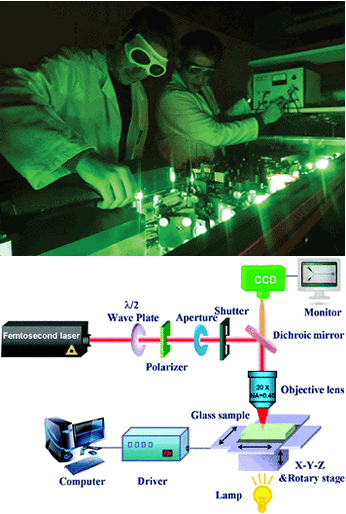
Commercial laser products are certified by the manufacturer, assigned into a number of classes by the CDRH Federal Laser Product Performance Standard (FLPPS – 21 CFR 1040) depending upon the power or energy of the beam and the wavelength of the emitted radiation. Laser classification is based on the laser’s potential for causing immediate injury to the eye or skin and/or the potential to cause a fire from direct exposure of the beam to a combustible material or from beam reflections to the same. A qualitative description of the laser classes can be found below.
Class | Laser Product Hazard | Product Examples | UVA Registration Required |
| 1, 1M | Considered non-hazardous. Hazard increases if viewed with optical aids, including magnifiers, binoculars, eye loupes, fiber inspection instruments or telescopes. | laser printers, CD/DVD players, Telecommunications fiber optics | No |
| 2, 2M | Hazard increases when viewed directly for long periods of time. Hazard increases if viewed with optical aids. | bar code scanners, alignment lasers | No |
| 3R | Depending on power and beam area, can be momentarily hazardous when directly viewed or when staring directly at the beam with an unaided eye. Risk of injury increases when viewed with optical aids. | laser pointers | No |
| 3B | Immediate skin hazard from direct beam and immediate eye hazard when viewed directly. | laser light show projectors, industrial lasers, research lasers | Yes |
| 4 | Immediate skin hazard and eye hazard from exposure to either the direct or reflected beam; may also present a fire hazard. | laser light show projectors, industrial lasers, research lasers, lasers used to perform LASIK eye surgery | Yes |
Laser Systems
UVA Fabricated Lasers - Homemade, original equipment manufacturer (OEM), non-certified and certified laser components and products and combinations are commonly in use in the research setting. Only certified commercial lasers are required to meet FLPPS requirements. (ANSI Z136.8-2012, 4.2). Therefore UVA Fabricated lasers are not classified.
Class 1 - Considered to be incapable of producing damaging radiation levels during operation, and exempt from any control measures.
NOTE: A common example of a Class 1 laser system is one that includes an embedded higher class laser, but during normal operation presents no laser radiation hazard to the user. Products that have been classified previously as Class IIa under FLPPS should be treated the same as those in Class 1. Confer with LSO for any reclassifications.

Class 1M - This class is safe for viewing directly with the naked eye, but may be hazardous to view directly with the aid of optical instruments. In general, the use of magnifying glasses increases the hazard from a widely-diverging beam (eg LEDs and bare laser diodes), and binoculars or telescopes increase the hazard from a wide, collimated beam (such as those used in open-beam telecommunications systems). Radiation in class 1M can be visible, invisible or both.
"M" stands for Magnifying Optics Caution.

Class 2 - Emits in the visible portion of the spectrum (400-700nm) and eye protection is normally afforded by the aversion response.


Class 2M - These are visible lasers. Total output is in excess of that normally permitted for Class 2 laser products but because of their diverging beams or very low power density are safe for accidental viewing during normal use as long as the natural aversion response is not overcome. However they may be hazardous to the eyes under certain conditions, even accidental viewing, if gathering optics are used with them, i.e.
a. With a diverging beam if optics are placed within 100mm of the source to concentrate/collimate the beam.
b. With a large diameter collimated beam viewed with binoculars or a telescope certain conditions.

Class 3R - (formerly ANSI Class 3a, CDRH Class IIIa and IEC Class 3B emitting less than 5 mW)
Has reduced control requirements and is potentially hazardous under some direct and specular reflection viewing conditions if the eye is appropriately focused and stable, but the probability of an actual injury is small. This laser will not pose either a fire hazard or diffuse reflection hazard.
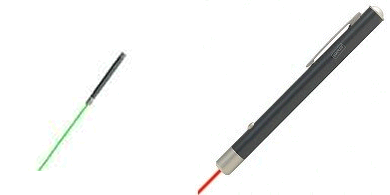
Class 3B - May be hazardous under direct and specular reflection viewing conditions, but is normally not a fire hazard, diffuse reflection hazard, nor a laser generated air contaminant (LGAC) production hazard. CAUTION: Some green laser pointers available on the web are 50mW and higher and can cause serious eye damage.

Class 4 - Is a hazard to the eye or skin from the direct beam, may pose a fire hazard or diffuse reflection hazard, and may also produce laser generated air contaminants (LGAC) and hazardous plasma radiation.