

Manual Material Handling (MMH) refers to the process of lifting, carrying, pushing, pulling, or moving objects by hand or bodily force. It’s a fundamental part of many industries, from construction and manufacturing to agriculture & logistics along with being a part of personal life. Manually handling heavy weights incorrectly can lead to serious injuries and long-term strain. Let this page be your guide to handling materials by using techniques that protect your body and boost your efficiency.
What is a power zone?
The power zone for lifting is close to the body, between mid-thigh and mid-chest height. Comparable to the strike zone in baseball, this zone is where arms and back can lift the most with the least amount of effort.
Why Lift in the Power Zone?
- Reduces risk of injury, especially to the back and shoulders.
- Maximizes strength by using your core and leg muscles.
- Improves efficiency and reduces fatigue.

What is Team Handling?
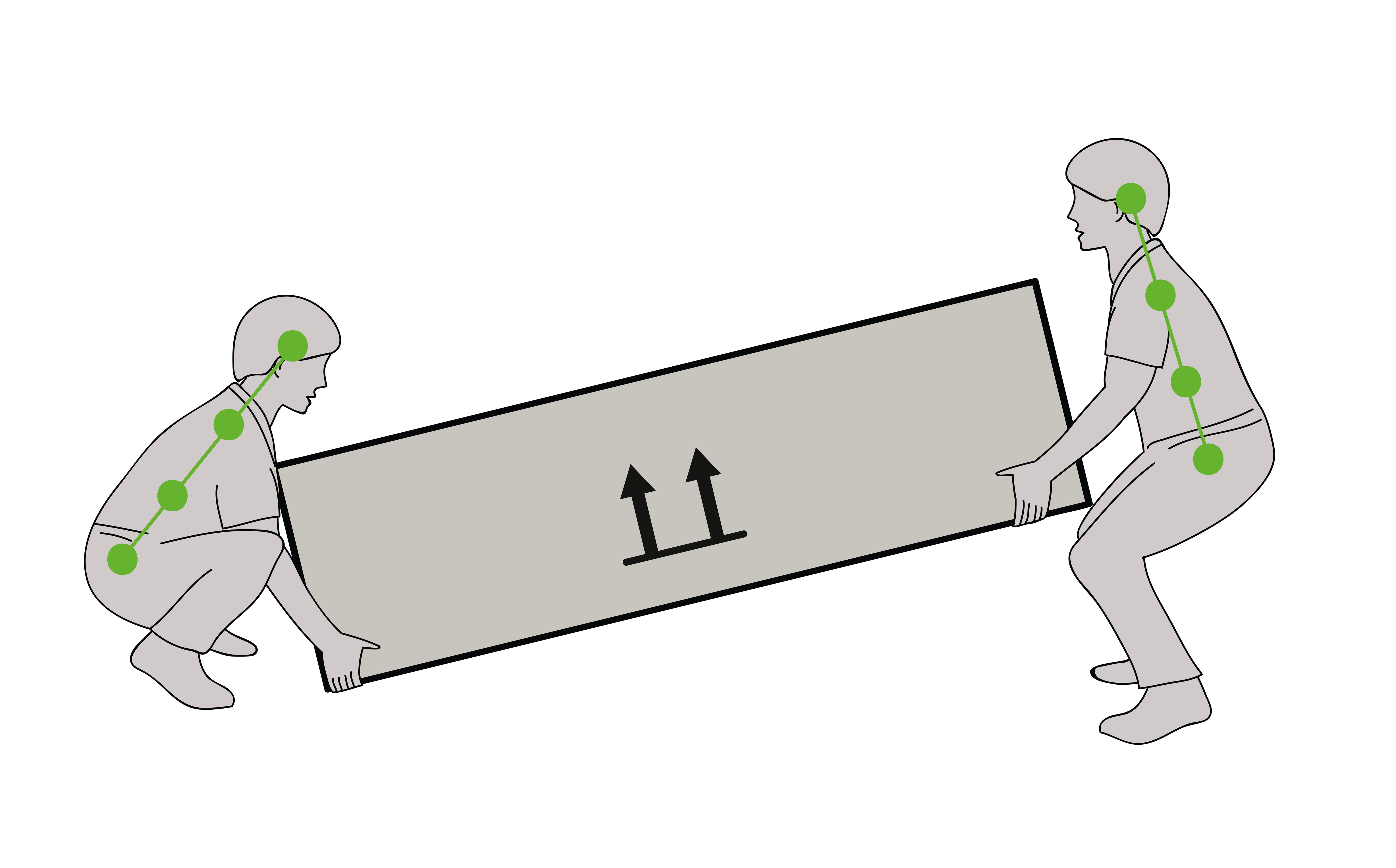
Team Handling is seen when more than one person is involved during the lift. It can be used when other lifting solutions are less appropriate for the situation.
Tips for a successful team lift:
- Select team members of similar height and strength.
- Assign a leader to the team.
- Determine set of commands such as "lift," "walk," "stop," and "down."
- Practice before actually performing the task.
For more information visit: CCOHS - MMH Team Handling
EHS X Green Labs - Ergonomic material Handling
As part of the Ergonomics program, it is essential to support our research community in working more sustainably with their musculoskeletal health. We've partnered with the UVA Green Labs Program to promote ergonomic practices tailored to the needs and experiences of our researchers.
Available to download: Ergonomic Material Handling | Environmental Health & Safety (EHS). Post this material around your lab to earn credit toward your Green Labs Certification.

Frequently Asked Questions
Assess the situation and ask yourself these questions:
- Is the load big, bulky, heavy?
- Do you need help? - If the load is more than half your body weight - GET HELP.
- Can you slide it instead of lifting it?
Push don't Pull.
after you've determined you have to lift it,
- Stand as close as possible to the load.
- Plant your feet firmly.
- Bend at your knees - Not your waist
- Breathe - If you must hold your breath to lift it, it is too heavy - GET HELP.
- Do not twist and lift.
- Do not lift loads across obstacles.
- Don't hold your breath while lifting.
- Don't lift objects while reaching or stretching.
- If the object is heavy, don't fight to recover a dropped object.
- Cluttered workspaces
- Poor lighting
- Extreme temperatures and noise
For more information on proper lifting techniques visit OSHA Proper Lifting Techniques: Safe Lifting Ergonomics
Stretch Breaks
UVA/EHS would like to thank UVA’s Dean Schlemmer (EHS, retired), Karen Allen (PT, UVA, retired), and Tina Andersen (PT, Bridges Wellness & Physical Therapy Consultants, LLC) for the production of the pictures below.
Please note that the following stretches are not specific to a work-related injury or illness and are only precautionary. Check the health of the chair prior to performing any of the following exercises. For individuals with existing injuries or recurring discomfort, consultation with a healthcare professional is advised to discuss the suitability of these stretches in light of an individual's specific condition(s). If you'd like to ask us a simple question or want us to cover a specific ergonomics related topic, feel free to use the Ask an expert form to convey your thoughts.

Place one hand on the wall, arm's length away and the other arm on your hips. Lift and rotate the outside leg as shown in the graphic and place it on the floor. Bring it back to neutral position and repeat the same with the opposite side. Reps: 3 - 5 on each side.

Sit upright and relax your shoulders. Lift your right leg and try to touch your toes with your left hand and vice versa. Reps: 3-5 on each side.

Place your left hand on the wall and the right hand on your hips. Raise your right leg as high as you can and then take it back as far as you can. Repeat the same motion with the other leg and your right hand on the wall. Reps: 3-5 on each side.

Place your feet approx. shoulder width apart, raise your arms to be parallel to the floor and swing them side-to-side, rotating your trunk in the same direction. Reps: 6 - 10 back and forth movements.

Start with an upright posture and then raise your right hand as high as you can and then alternate with your left hand. Reps: 5-7 times on each side.
The bottom line is that YOU bear the responsibility for preventing back injury.